
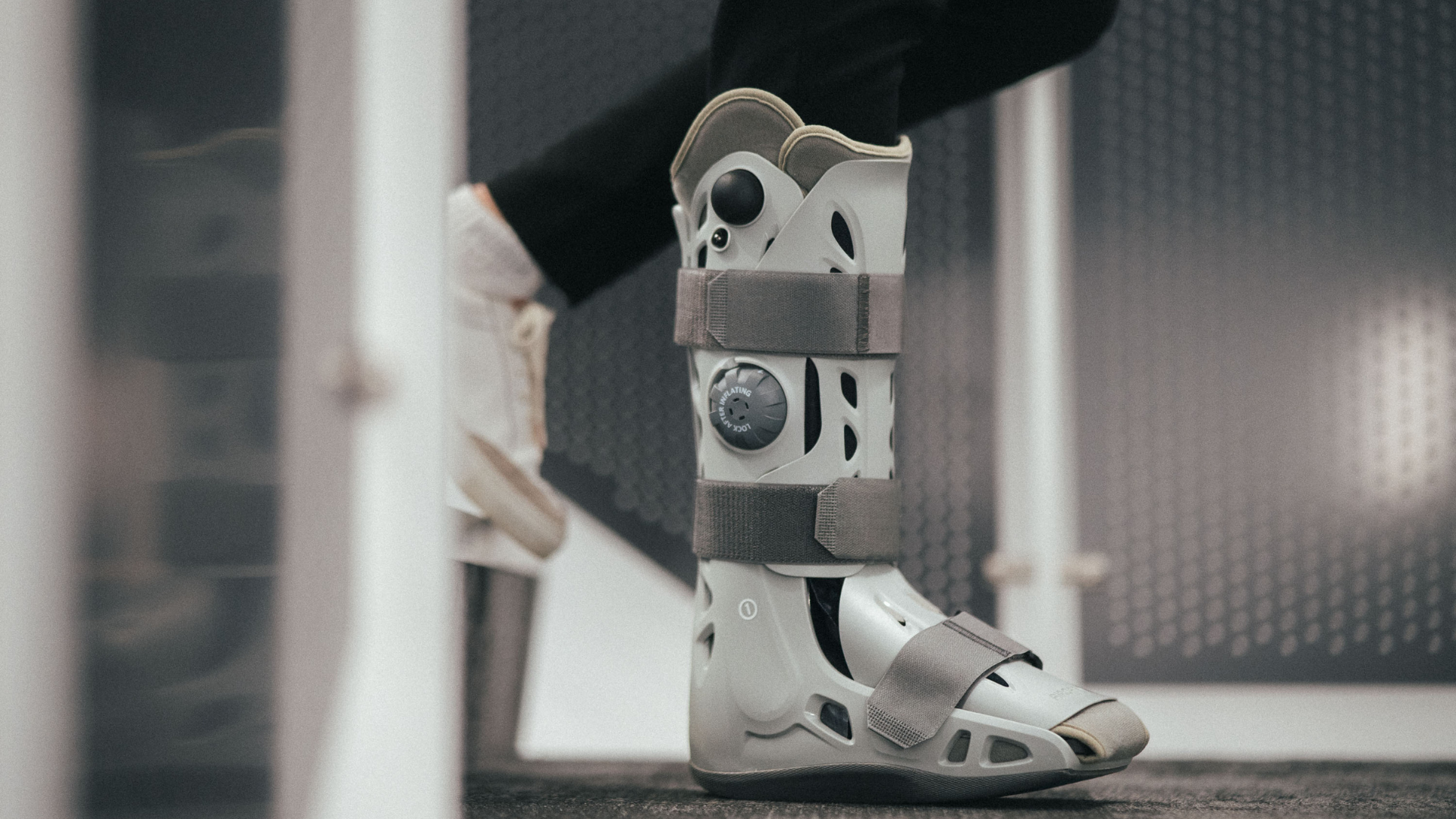
Since 2007, Dr. Jim Richards, Professor of Biomechanics and Director of Research for the School of Health, Social Work and Sport at the University of Lancashire has been working with Enovis (formerly DJO), a medical technology company specialising in orthopaedics. His work with Enovis includes studying the usability of orthotic walker boots through biomechanical analysis. Orthotic walker boots are devices commonly used in the rehabilitation of ankle fractures, Achilles tendon ruptures and other lower-limb injuries.
At the University’s state-of-the-art facility in Preston, Professor Richards and his team have been conducting advanced testing to measure how walker boots influence movement patterns. Using sophisticated motion-capture and imaging systems, they analyse the effects these devices have on gait, joint loading, and overall mobility.
Their first collaborative study with Enovis, published in 2016, revealed that differences in boot design can significantly alter a patient’s ability to walk safely and comfortably. Notably, the team found that their publication was the first to examine walker boots from a biomechanical perspective.
"Our motivation is to improve treatment options and patient care."
— Dr Jim Richards, Professor of Biomechanics and Director of Research for the School of Health, Social Work and Sport
“We noticed considerable variation in the design of these walkers from different manufacturers,” explained Professor Richards. “For instance, we saw key differences in how far forward the tibia is inclined as well as the sole profile.”
He added: “If you’ve had an ankle injury or Achilles rupture, one of the things you’ll want to encourage within the rehabilitation is graduated loading, where you gradually increase the amount of load going onto the leg. If orthotic walkers are difficult to walk in, you’ll have abnormal loads going through the body which may be problematic or ill-advised."
This research identified specific elements of walker boot design to be considered when attempting to provide clinical effectiveness. By sharing these findings with Enovis, Professor Richards and his team believe that they can directly influence product development for the benefit of future patients.
“Our motivation is to improve treatment options and patient care,” said Professor Richards. “Anything we can do to improve products means that they’re more effective at reducing pain, improving dynamic stability of joints, and improving clinical outcomes.”
"Collaborating with Professor Richards and his team allows us to ground our product development in rigorous biomechanical research."
— Lorraine Dupuit, International Business Director, Bracing & Supports - Vascular at Enovis
Professor Richards’s team continues to collaborate with Enovis on the biomechanical evaluation of various orthopaedic devices currently in development, with plans for further research once these products reach the market.
“Collaborating with Professor Richards and his team allows us to ground our product development in rigorous biomechanical research,” said Lorraine Dupuit, International Business Director, Bracing & Supports - Vascular at Enovis. “These insights help us create innovative products that better serve patients and clinicians.”
When asked about what impact this research is having, Professor Richards commented: “By giving us a direct role in the research and development of their products, companies can enter the market with confidence, while the public should benefit from better products that support faster and safer recovery.”


